
Your cart is empty now.

The Dekrypticus: The Chair, the Readout, and the Death of the Private Mind
Of all the relics inherited from the Elder World, few have been more praised, more cursed, more studied, and more misunderstood than the Dekrypticus.
This was no ordinary machine.
That is the first error made by those who speak of it carelessly. They call it an instrument of the courts. They call it a forensic chair. They call it a truth device. They call it the final witness. These names are useful to children, officials, and those who prefer their history filtered enough to digest. These names are not useful to those who labor to understand.
The Dekrypticus was something worse–a pry bar wielded against the mind.
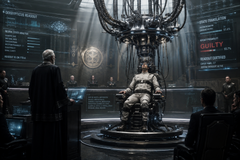
The old machine deconstructed neural biology into tidy little readouts. A set of lines marched across a screen for someone else to read. Memory, agitation, recognition, resistance, fear, repetition, fatigue, and suggestion all became entries in a language of state. The subject sat bound beneath the casing. Thick cables descended. Heavy restraints held the body still. The headpiece lowered.
Then the mind ceased to be private.
The Dekrypticus revealed truth in larger brush strokes than traditional evidentiary practice. Those methods were always tangential to the truth. This misunderstanding has always been the refuge of its defenders.
The machine read state, and state could be made.
Vater Haolf and the First Great Use
The name Vater Haolf survives in Mark Twelve with the strange shine reserved for figures no one can safely condemn.
He was an important person of the Elder World. Some would say wise. Others, more quietly, would say that he understood the mind only well enough to injure it.
In the histories taught to the young, Haolf appears beside Senator Watts, who opposed implementation. Watts was broadly known, defiant, set against the age moving around him. He was given a choice: make a deal or face the chair. He chose the chair.
That choice became history.
In the Elder World courts, confession had already fallen under suspicion. Testimony could be coached. Experts could be purchased. Audio could be altered. Video could be staged. Reports could be constructed close enough to fact to be fatally persuasive. The old judiciary had begun to distrust the human mouth and hand.
It wanted readout.
This hunger made the Dekrypticus possible.
Yet the terrible brilliance of Haolf lay not in his confidence in the machine, but in his contempt for the myth surrounding it. Haolf understood what lesser men did not. The mind is not legible when it is unsettled. A subject can be made unreadable on purpose. More importantly, a subject can be conditioned for the machine, unseen paths plowed in the mind and laid to bear for the nanofiber feelers.
Preparation, when performed by a professional, carries more weight than the readout. It looks like an isolated mind. A fatigued mind. A suggestion planted early enough to return a readout that missed the mark entirely.
By the time the Dekrypticus read Watts, Watts was already cooperating. He did not cooperate by choice. His mind had been turned toward the place where Haolf needed the readout to land.
The machine ran.
The readout stamped guilty.
And with that stamp, the Elder World crossed over a threshold of no return.
Watts v. Washington and the Court’s Rupture
The controversy did not end with Watts. It began there.
Watts v. Washington, Federal Circuit, year 2070, became the scar through which the Dekrypticus entered trial practice. Senator Watts was the only member to vote against implementation before the bill was called. His prosecution therefore carried an odor no procedural perfume could conceal.
The court’s hands were said to be tied.
Judge Jhobsian’s later resignation deepened the wound. His public address was brief enough to become infamous. He wrote that he had a duty to his son from which no father could abstain. Nothing else followed. Only that sentence, dressed in the propriety of unfortunate familial circumstance.
The public cried foul play, but their opinion mattered less than it should have.
The threshold had been crossed. Beyond it lay cracks. The Dekrypticus, beginning with Watts, became the standard implementation of trial. It entered the courts not as a neutral instrument that had earned trust, but as a device too useful to be refused by powers already frightened of uncertainty.
From that point forward, the accused faced only the testimony of his mind. He faced interpretation of his own neural condition.
The witness had been moved inside the skull.
The False Promise of Justice
There were cities that implemented the Dekrypticus almost exclusively.
Their defenders still recite the old numbers with devotional satisfaction. False conviction rates dropped. Prison overcrowding vanished. Crime plummeted. The rhetoric was impressive enough, almost beautiful in its simplicity. A man with a secret became the most dangerous kind of citizen, and the Dekrypticus promised to end the age of secrets.
To its advocates, the device was a reckoning.
Guilt could no longer hide behind masks, brazen lies, or fortunes hoarded offshore to purchase silence and immunity. No more false tears. No more rehearsed innocence. No more escape by eloquence, office, bloodline, charm, or pleading amendments. The machine would take man beyond the theater of speech and place him before the cold structure of himself.
That was the promise.
But a readout is limited in its ability to convey truth.
The early numbers, drawn from a limited number of cities, did not prove what their champions claimed. A narrow implementation could not answer every question of bias, scale, abuse, selection, coercion, adaptation, and institutional corruption. A city that measures fewer harms may claim fewer harms. A system that defines its own success may produce success in beautiful columns.
Bias can still call itself science. Judges could bury their heads in the sand while men like Vater Haolf confused the readout. It was less work for them. The machine was truth, and the machine could not lie.
It wasn't a question of whether the Dekrypticus replaced the court. The real question was whether any court using it could resist the temptation to make the readout sovereign.
The Elder World could not.
The Right to the Mind
The great moral objection to the Dekrypticus ripened out of age old natural laws.
To man goes his mind.
That sentence, associated in later instruction with Ptrause Ledvane and the Trishula, became the cleanest rebuke to the machine’s defenders. A person’s thoughts, memories, conscious processes, subconscious disturbances, recognitions, and fears are not common property. They are not abandoned merely because an allegation has been made. They are not a public quarry from which the state may extract convenient stone.
The Dekrypticus violated the last interior border.
The issue was not simply privacy in the ordinary sense. Citizens of Mark Twelve, especially the young, often make a comedy of privacy. They log their movements, opinions, purchases, conflicts, illnesses, entertainments, and performances across the IPF with cheerful abandon. They mistake voluntary exposure for the extinction of the right itself.
That notion was dangerous in of itself.
A person may speak foolishly in a forum and still retain dominion over the unspoken mind. A person may reveal one thought and still own the next. The law does not gain title to the whole island because a fool lights a signal fire on the beach.
The Dekrypticus made accusation itself the key to entry.
Its critics saw the danger clearly. If serious allegation can divest a person of mental privacy, then power need only become skilled at allegation. Slight suspicion becomes a warrant. Cumbersome procedure becomes diligence. Protecting the record becomes paternalism. The court becomes the injurious party while claiming to act for the accused’s own good.
Freedom, then, is reduced in the name of protecting freedom from those who might misuse it.
This was the slope. And it was slippery because of how far the definition of plausibility had fallen.
The Science and the Expert
The first courtroom Dekrypticus did not eliminate human interpretation.
That fact is often lost beneath the later legend. The premier device required experts to attend the readout, interpret the patterns, and provide immediate fact-based simplifications for the court. Each conclusion was supposed to withstand strict scrutiny. Each finding was supposed to be supported by compelling evidence. The judge remained present, at least in theory, as a guardian between state and soul.
This arrangement gave the device a legal costume.
It allowed defenders to claim that the Dekrypticus did not judge. Experts judged. The court judged. The machine merely assisted.
Yet every costume reveals the body beneath it when pulled tight enough.
The more the courts trusted readout, the less they trusted speech. The more they trusted experts, the more expert interpretation became a priesthood. The more the device entered trial practice, the harder it became to exclude. A court that has seen the mind displayed in lines becomes impatient with ordinary uncertainty.
Later came the ambition to remove even the expert.
There were attempts to develop models capable of supplanting the expert role with their own analysis. The old terms survive: convolutional neural network, database extrapolation, automated pattern recognition, predictive adjudicative synthesis. Whether those applications ever gained formal allowance for use mattered less than the direction of desire. The Elder World did not merely want a machine that could assist the judge.
It wanted a machine that could become judge.
Had that line fully matured, the Neptutial judge of Mark Twelve might have found an ancestor in a device built to collapse fact, interpretation, and sentencing into a single operation.
Preference, Nature, and the Ideology of Selection
The Dekrypticus did not remain a legal machine. No object that touches the mind can remain only legal.
By the time Mark Twelve teaches the Dekrypticus to its students, it has become philosophy.
The lesson is not confined to Watts, Haolf, the chair, or the readout. It opens into preference. Status. Nature. Selection. The right of the few to rise and the supposed inevitability that the many must be diminished.
For students at the Pavilion of Tomorrow, the Mark's school for the elite, the Dekrypticus emerged from the Elder World’s deepest hypocrisy. The Elder World spoke of law, equality, and non-preference while building courts, infrastructures, climates, architectures, and protected systems to defeat the raw movements of Nature. It claimed to resist natural hierarchy, yet its own institutions selected constantly. They selected whom to shield, whom to punish, whom to believe, whom to preserve, whom to discard. They called the process justice because they feared naming it preference.
The Dekrypticus stripped away the disguise.
If Nature prefers, so must civilization. If apex status exists in the body of the world, then status must be earned, protected, displayed, and enforced. If the few rise, the many must be lowered by the same motion. To elevate is to diminish. To prefer is to exclude. To build order is to give violence a lawful form.
This is the terrible philosophical inheritance Mark Twelve draws from the machine.
The Dekrypticus becomes proof, in the mouths of its defenders, that impartiality was always a fraud. The Elder World did not fail because it selected. It failed because it pretended not to.
Against that claim stands the older fear: that once a civilization admits its preferences without shame, it will begin deciding who deserves death.
Mark Twelve knows this rhetoric.
It has heard it before.
The Pavilion and Open Dialogue
In the Pavilion of Tomorrow, the Dekrypticus is not treated as dead history. It is placed before the young as a living inheritance.
To begin their rigorous studies, students pour out predispositions, temperaments, derelictions and the IPF forum grades them. Their seats are assigned. Rank is ever so important. The chocosa line divides the preferred from all others.
The lecture hall itself becomes a descendant of the Dekrypticus.
The students learn in the modern form of it.
Every movement, every choice, every statement in the forum has already become a readout for those on the other side of the wall. Their seats are not arbitrary. Their freedom to speak is not equal. Their rank is paramount.
The classroom becomes the Elder World in miniature.
The Modern Implementation in Mark Twelve
Mark Twelve does not need to place every citizen in the old chair. That would be crude, and Mark Twelve prefers refinement.
The modern Dekrypticus lives through the IPF, the forum, classroom rankings, institutional seating, open dialogue, diligence measures, status assignments, and the endless conversion of conduct into standing. The old machine required a subject to be restrained beneath a headpiece. The modern form invites the subject to participate.
The citizen logs. The student argues. The child performs.
The ambitious expose themselves. The frightened imitate. The ranked defend ranking because ranking has favored them. The diminished contemplate the discipline they supposedly failed to earn.
In this sense, the Dekrypticus has escaped its casing. It no longer needs thick cables and chain restraints to function. It works through voluntary disclosure, educational sorting, political posturing, and the cultural belief that privacy is something one earns after proving one deserves it.
That belief is among the most dangerous in Mark Twelve. It turns interior life into conditional property. It makes the mind available to power whenever power so desires.
The machine only answers to one authority.
Not truth.
Not the court.
Not the accused.
To order.
Share:
Recent Post


Translation missing: en.general.search.loading