
Your cart is empty now.

How Stories Are Built: The Writing Process Behind Order is Violence
- 06 March, 2026
- Adam Freeland
Order is Violence began as a single idea scribbled during my days studying biology. That idea refused to stay small.
As I continued my education in law, the story grew in complexity. Questions of faith, technology, survival, and power became central. What would happen if human civilization pushed too far? What would ordinary people do when trapped between systems of control and the fight for freedom?
Those questions became the backbone of the saga. Today, Order is Violence is more than just a book series, its designed to challenge how we think about survival, morality, and choice.
The first scene of the book that I wrote was about the main character, Ahra Fluoresce, in her most private setting. Her room. It's morning, and she's getting ready for school. She comes across as gentle and intelligent through the simplest part of her morning: getting ready for the day while talking with a program on her IPF, a smart-device interface, and quietly working through how she plans to answer the class assignment.
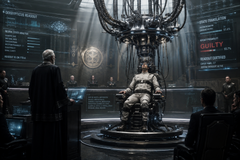
The assignment is about the morality of giving up autonomy as a society and handing it over to a machine. A courtroom machine that determines guilt based on a brain scan conducted live and in court by court officials. The autonomy relinquished belonged to the jury. They decided guilt, once upon a time. But, as you can see in the very scene, Ahra gives up some autonomy too, by asking the machine for its opinion. Yet, she writes down an answer that would indicate she believes such a practice to be wrong.
This is just one example of how I choose to write my characters. They aren't perfect, and they grapple with things far bigger than themselves right out of the gate. But I assure you, by the end of all of this, Ahra will grapple with this exact question once more, and this time, at least when I sit down to write it, I hope she realizes how important her answer will be to the people in the Order is Violence universe. And hopefully one day to us.
Search
Custom Menu
Recent Post


FROM_JS
jsprice
jsprice
FROM_JS
FROM_JS
Add to cart
Added
Limit Products
Wait..
Translation missing: en.general.search.loading